THE ICON
St. Louis' Adopted Son. Rooted in Richmond. He became Arthur Ashe here.
Where He Came From
Arthur didn't choose tennis. It chose him. His father was superintendent of Brook Field, Richmond's largest Black park, and the job came with a caretaker's cottage just a stone's throw from the courts. His classmates called him Skinny and Bones. Too fragile for football. Too slow for track. So he picked up a racket and spent every day on the courts outside his window.
Life didn't make it easy. Measles, chickenpox, mumps, whooping cough, diphtheria, all before he turned ten. He lost his mother suddenly when he was seven. And he grew up in a city that told him where he could walk, learn, eat, and play, based on the color of his skin. His teachers were direct about what that meant for a Black kid who wanted to go somewhere: you're going to have to work twice as hard. So he attacked school the same way he attacked tennis. Quietly. Relentlessly.
What he had going for him were people who cared. Dr. Walter Johnson, who also coached Althea Gibson, took Arthur under his wing, fine-tuning his game and his temperament. He taught him to return every ball within two inches of the line and never argue with an umpire. Johnson knew Black players didn't have room for error. It was the foundation for the sportsmanship that would define Arthur's legacy.
Virginia kept getting in the way, though. Even in winter, Arthur could only play outdoor courts against the handful of Black players in Richmond. When Johnson told him he'd be finishing high school in St. Louis, Arthur had only three weeks to get used to the idea. He wanted to graduate with his friends, the kids he'd grown up with. But Johnson had already given him so much. Arthur felt like he owed him this. So Johnson handed him off to the one person he trusted to take him the rest of the way.
The Man Who Made It Possible
Richard Hudlin was a Black schoolteacher at Sumner High School, former captain of the University of Chicago tennis team, and the only Black player ever to captain a Big Ten university tennis team. He was also one of the most quietly consequential figures in American tennis history.
In 1945, Hudlin sued the city of St. Louis to integrate its tennis courts and tournaments. He won. By the time Arthur arrived for his senior year in 1960, the courts were open and the color line was gone. Hudlin had made sure of it.
He treated Ashe like his own son. His home was Arthur's home, even if Hudlin's own son Dickie didn't love sharing it. He covered Arthur's expenses and trained him with the intensity of someone who knows exactly what it costs to fight for something. Push-ups every morning. School until noon. Tennis all afternoon. Long runs before dinner. Arthur graduated from Sumner with the highest GPA in his class and was featured in Sports Illustrated's Faces in the Crowd as the first Black player to win a National Indoor title.
Hudlin didn't just make him a champion. He made him Arthur Ashe.
What St. Louis Made Possible
Ashe arrived and found something Richmond could never give him: open courts, real competition, a city where Black and white players pushed each other to get better.
St. Louis had more quality tennis players than any city outside greater Los Angeles, and LA had ten times the population. Still, St. Louis had Butch Buchholz, his brother Cliff, Chuck McKinley, Rod Susman, Jim Parker, Dick Horwitz, Frank Conner. Ashe trained alongside all of them. Decades later, Buchholz would say it himself: without Arthur Ashe first in St. Louis, there's no Arthur Ashe Stadium.
One of those players was Jimmy Parker, who Arthur already knew from the National Boys 15s. Jimmy Parker's father, Ward, was an educator and knew Hudlin well. As a principal and troubleshooter at newly integrated schools in the St. Louis Public Schools system, he was assigned to ease racial tensions. He encouraged his son to look out for Arthur. He didn't need to. Both boys were skinny, shy, studious, and hit it off over their love of reading. Jimmy went to Ladue. Arthur to Sumner. Most days Jimmy picked Arthur up after school and the two headed to the Armory together, and while they waited for a court they'd pull out their books and find somewhere quiet.
Jimmy took Arthur to his all-white club to practice. Mid-set, a member came up behind their court shouting expletives and spewing racial slurs, demanding to know what Jimmy was doing bringing that you-know-what into his club. Jimmy wanted to ram his racket into the man’s face but the holes in the chain link fence were too small. Arthur was unfazed. Jimmy asked him how he stayed so calm. Arthur shrugged. "That's how it is," he said. Then, dryly: "I wouldn't mind seeing it change, though."
Arthur never threw a racket. Never argued a call. Years later, already a huge star, Arthur said: "Remember, the Black players that follow may not all be like me."
The restaurant across the street from the Armory refused to serve Arthur when he came in with Jimmy. When Jimmy told Larry Miller, Larry spread the word, and the players stopped going. To them it was cruel and unjust and worth doing something about. Arthur didn't make much of it at all.
The Armory itself was different. Race didn't matter. The only thing that separated them there was the net.
Arthur had been a clay court player. His long, flowing strokes were built for slow red dirt. On the fast, slick boards of the Armory, that game fell apart. Cliff Buchholz and Jimmy, who'd been about even with him outdoors, started beating him easily indoors. By the time Arthur would finish his wind-up, the ball had already rocketed past him.
Larry Miller, the pro at the Armory, took pity on Arthur, and rebuilt his game from the floor up, for free. Take the ball on the rise. Topspin on the backhand. Get to the net. Arthur's national ranking jumped from 44 to 12 in a single year. He topped it off by beating Cliff in the National Indoor final, on the same court where Cliff had walloped him just months earlier. He later said what he learned on those boards carried him to his grass-court titles at Wimbledon, the US Open, and the Australian Open.
In 1961, the National Interscholastic Championships returned to Charlottesville, Virginia, Arthur's home state. Dr. Johnson had spent years fighting to get Black players into that draw. When organizers realized a Black player actually had a chance to win it, they petitioned to cancel the tournament. They were denied.
Arthur beat Jimmy Parker in the final. Jimmy was crushed at the time. Dr. Johnson, watching from the stands, was ecstatic. It was the first national title ever won by a Black man, the first of many firsts for Arthur. Charlottesville never hosted the tournament again.
Jimmy didn't understand the weight of that day until years later. Once he did, he wasn't sorry he'd lost. He was grateful he'd been there.
St. Louis led to UCLA. Coach J.D. Morgan had scouted Ashe and offered him a full ride. Under Morgan and Pancho Gonzalez, Arthur's serve got more explosive, his net game more dangerous. He won the NCAA Championships and graduated with a degree in Business Administration, a long way from a frail kid in segregated Richmond.
In his autobiography, Ashe wrote that he believed he was destined to do more than hit tennis balls. St. Louis is where he started to understand what that meant.
Champion on the Court
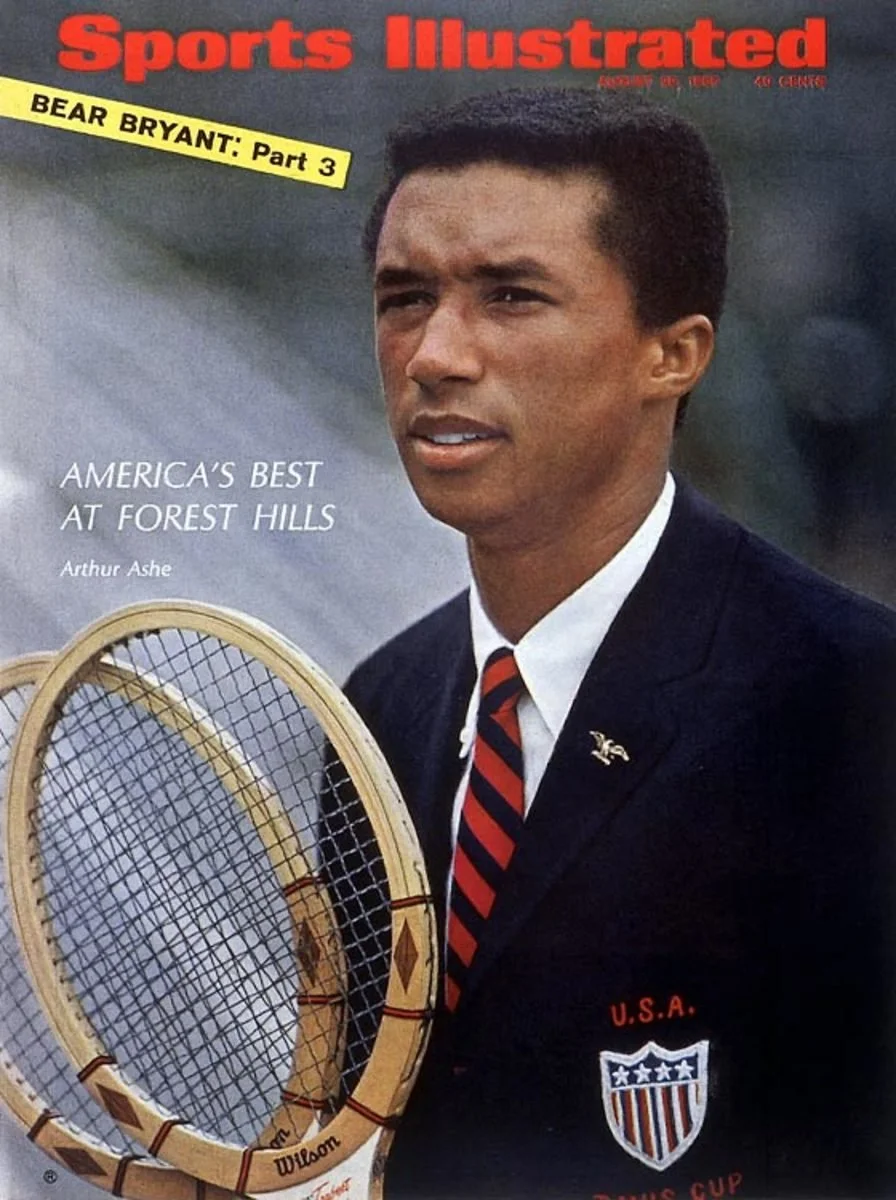
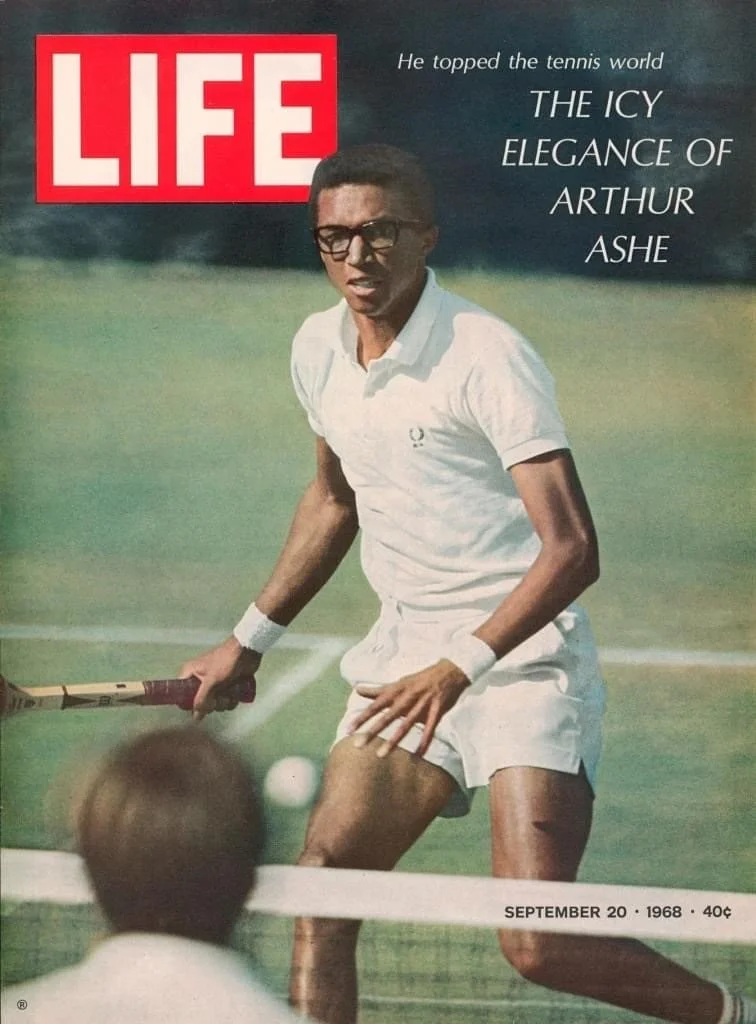
In 1968, Ashe won the first US Open of the Open Era, the first Black player to win the title, and the only player ever to win both the amateur and open national championships in the same year. That same year, he became the first Black player to represent the United States in the Davis Cup.
He wasn't just the best Black player. On his best days, nobody was better.
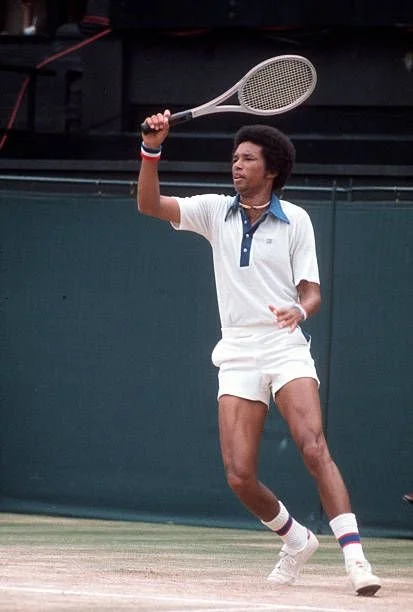
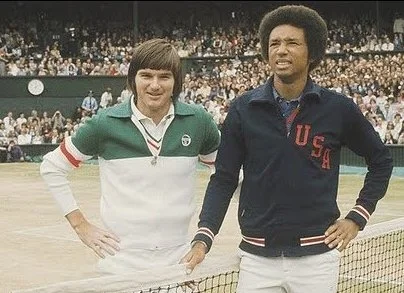
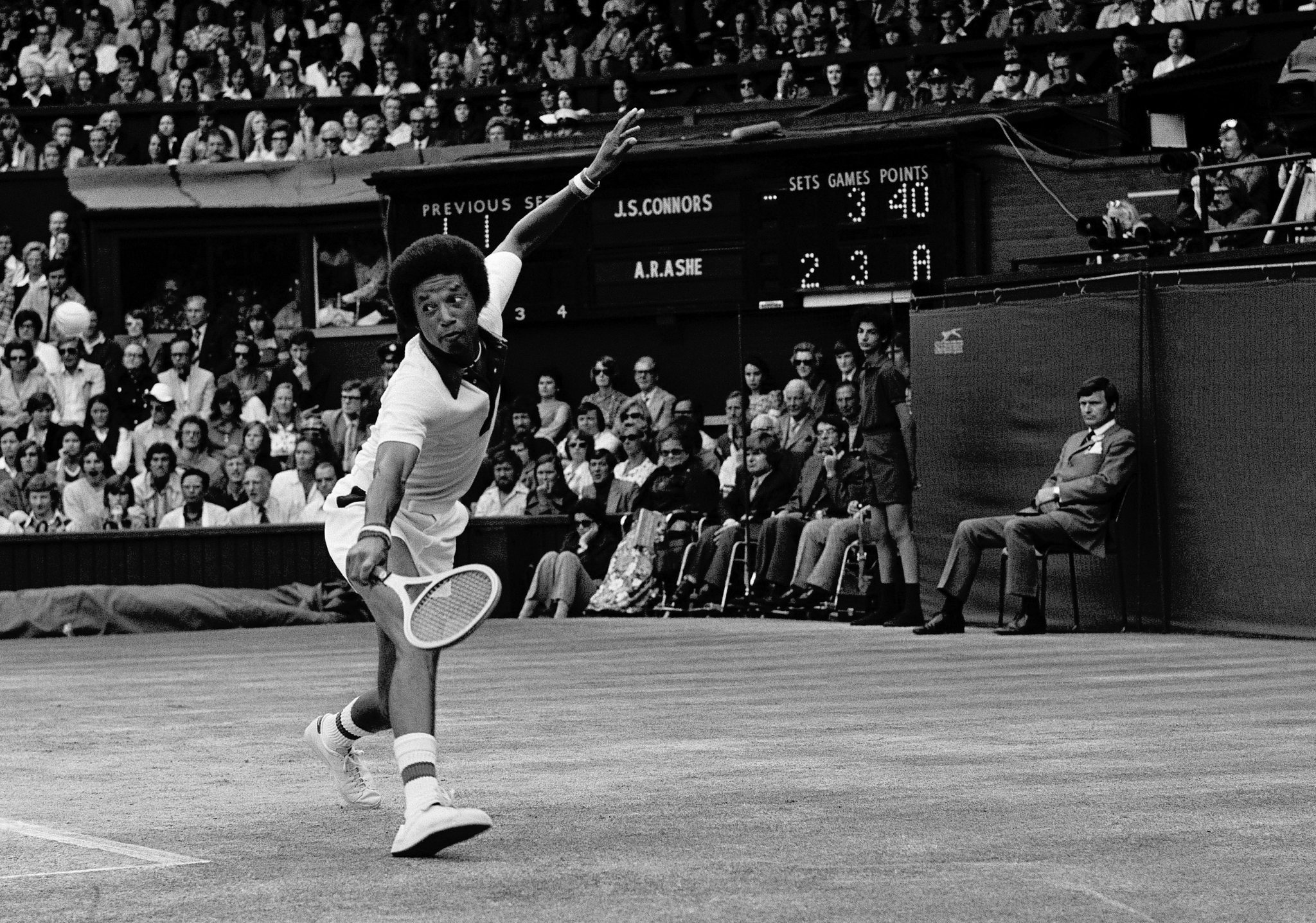
Three Grand Slams. In 1975, he beat defending champion and world No. 1 Jimmy Connors at Wimbledon in a stunning upset and was named ATP Player of the Year. His Davis Cup record was 27–5. He captained the team from 1981 to 1985, winning two Cups.
Champion off the Court
The records are impressive. What he did with the platform they gave him was something else.
He fought apartheid in South Africa when other athletes looked away. In 1985, he was arrested outside the South African Embassy in Washington. In 1992, arrested again, this time outside the White House, protesting U.S. treatment of Haitian refugees.
That same year, he disclosed his AIDS diagnosis, contracted from a blood transfusion. A reporter asked if it was the toughest thing he'd ever had to face. "No," Arthur said. "Being a Black man is." He didn't retreat. He founded the Arthur Ashe Foundation for the Defeat of AIDS, spoke before the U.N. General Assembly on World AIDS Day, and wrote that he had to seize these opportunities to spread the word. Two months before he died, he founded the Arthur Ashe Institute for Urban Health and finished the book.
He co-founded the National Junior Tennis League, which now reaches 160,000 young people a year, not to produce pros, but to teach life skills. And he wrote A Hard Road to Glory in three volumes, because a complete history of the Black American athlete didn't exist, and he thought it should.
A Legacy Left Behind
Renée Blount was a local Black player Arthur mentored for years. In 1979, she became the first Black woman to win a professional tennis tournament.
The first time they met, she managed only a shaky handshake. Arthur looked her in the eye and told her to skip the formality. "Just call me Art," he said. That didn't mean he'd go easy on her. Arthur saw something in her. But it wouldn't matter until she saw it too. "What do you want?" he asked. Wimbledon, she said. He didn't sugarcoat it: that would be hard. She said she knew, and she'd hit 500 serves a day if that's what it took to get there. She hit 600. In 1981, she made the main draw of Wimbledon. Arthur was there, a past champion himself, surrounded by players and celebrities at the Wimbledon welcome breakfast. He crossed the floor and held out his hand, and she took it firmly in hers. "Welcome to the club," he said. They were the only two Black players in a room filled with the very best in the world.
When Arthur was traveling through Cameroon, he stopped in a small village and met a boy who owned one homemade tennis racket. Arthur gave him one of his own. The boy slept with that racket and dreamt of turning pro. Yannick Noah went on to win the French Open.
Juan Farrow came up the same way, shaped by Hudlin, supported by Ashe. Arthur called regularly to check on his progress and helped cover expenses when Juan traveled to out-of-state tournaments. Juan became a three-time collegiate national singles champion at SIU and is now a teaching pro in Macon, Georgia.
When St. Louis player Bruce Foxworth suffered a spinal cord injury in a car accident and the medical bills piled up, Arthur sent him a check. Bruce paid it forward, becoming director of the junior program at the Los Angeles Tennis Club, one of the most exclusive, historically segregated clubs in American tennis. He showed up with dreadlocks and a reputation for never raising his voice. His students were devoted. He knew exactly who he was. Arthur would have loved it.
One Last Goodbye
Arthur's last appearance in St. Louis was May 1992, at the Triple A Club. Rain was in the forecast. It didn't keep the crowd away. Only a month earlier he'd disclosed his AIDS diagnosis, and he wasn't sure he'd be up to it. But he didn't want to disappoint the city that had shown up for him. He took the podium and talked about his St. Louis days, what they meant, the doors they opened that he never expected. As soon as he finished, the sky opened up.
Arthur Ashe died in February 1993. He was 49.