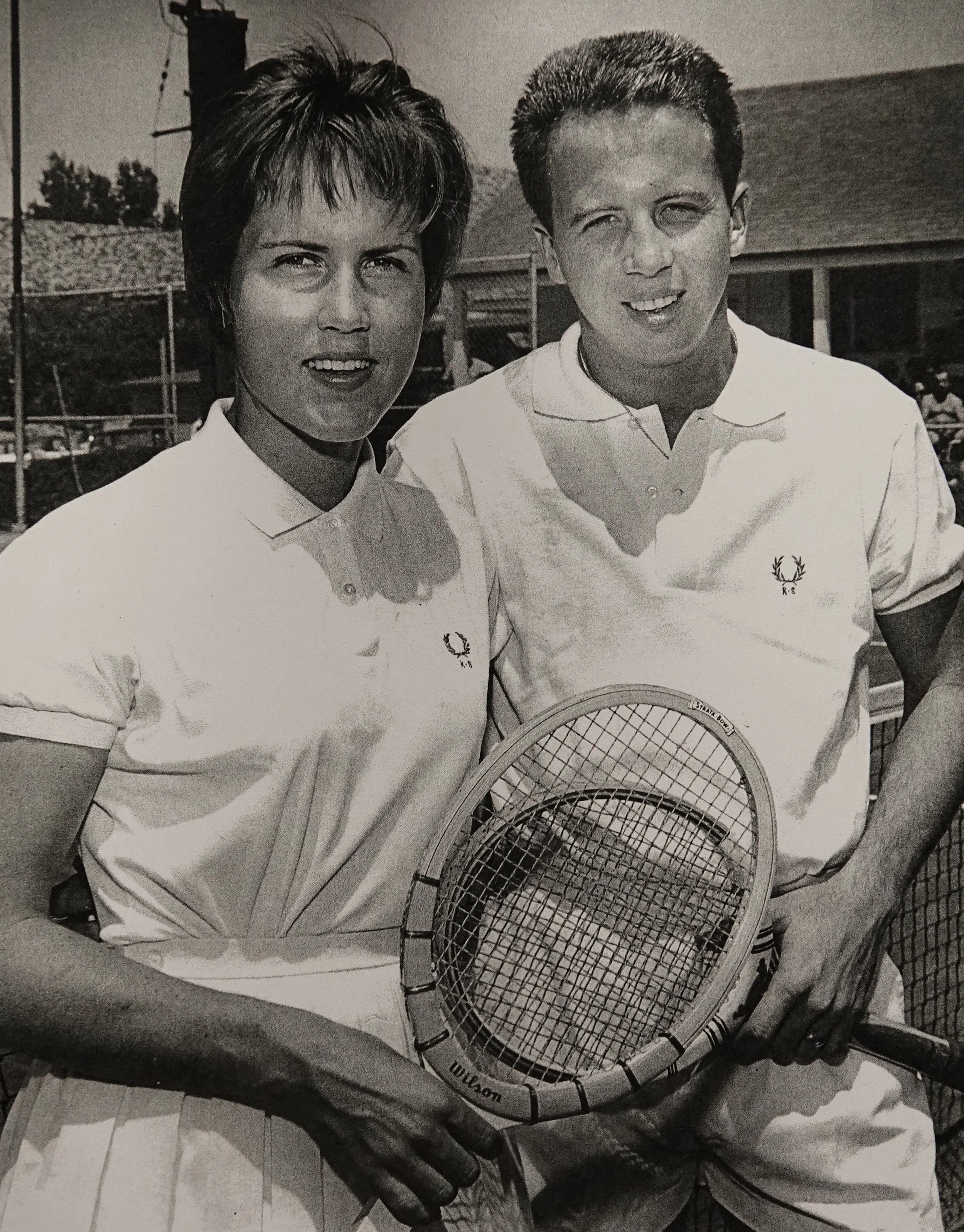
ROD SUSMAN
Rod Susman chose tennis over baseball. He'd made a Missouri all-star midget league team, and had a shot to play at Busch Stadium. Baseball is what a kid from St. Louis was supposed to want to do. He picked tennis instead, working his way up through Earl Buchholz Sr.'s clinics.
He was good. All-American at Trinity. Top 20 in the world in his twenties.
Then it got complicated.
Rod was playing a tournament at the Merion Cricket Club in Philadelphia. Rain moved his match from grass to hard court, and the new location had nothing set up. No towels. No drinks. He called out to the crowd, half joking, "Would somebody bring me a towel and a Coca-Cola?"
A girl brought them. Karen Hantze. A national junior phenom at 15, 5th in the world at 17. The USLTA had big plans for her, and they did not include Rod. When he started showing up at her matches, the USLTA restricted where he could play. It backfired. "It kind of drew us together, actually," Rod said. "That was their mistake."
They married in 1961. He was 21. She was 18. An oilman from Texas funding Trinity's tennis program didn't approve of the marriage. He pulled Rod's extra perks.
Karen took a minimum wage job as a file clerk at an insurance company in San Antonio, while Rod finished his classes. One minute she's on Center Court hoisting the Wimbledon doubles cup with Billie Jean King, the next she's pushing paper. "On rare occasions I'd hit with her on a weekend when we (Trinity) weren't traveling as a team, and other than that she didn't hit another ball until May the following year."
Two months later, she won Wimbledon without losing a set.
Rod was building his own record too. Two-time National Public Parks singles champion. Quarterfinals in mixed doubles at Wimbledon, with Karen. When the USLTA suspended her nine months in 1963 over a broken reimbursement promise, a federal judge cut it to six. Her career never really recovered. Rod's did, just in a different direction. He came home to St. Louis in 1965 and spent six years with an insurance agency.
In 1972 they moved to San Diego, Karen's hometown, where Rod started his own firm and threw himself into auto racing. He spent the next forty years in it, qualifying for nationals seven or eight times. These days he's mostly a senior and chief instructor at race schools up and down the West Coast.
"I would classify myself as a journeyman race car driver," he said. "Acceptable on a national competition level."
They haven't been back to Wimbledon since the centennial in 1977. A few years ago a writer asked to see Karen's trophies. Nobody in the house knew where they were. They'd been packed away in a move and forgotten. Karen went looking and found them in a box.
Rod put them on display. He's the one who remembered they mattered.
(1994)