
How Bruce Foxworth Changed the Rules of the Game
The tennis pro specialized in defying expectations.
By Susan Orlean
As seen in the New Yorker
In the eyes of at least a few, Carol became a pioneer of sorts in sports when she teamed with Arthur Ashe in 1963 and 1964 to play mixed doubles at Wimbledon, making them only the second mixed-race team in the tournament’s history. Carol says she didn’t think much about it until around 2000 when a pastor at her church “told me how excited his brothers in Mississippi were that Carol Hanks was now one of his members.”
Carol said the comment made her feel good, but it also reminded her that her tennis career and new marriage to Don Aucamp kept her so busy, “I didn’t do a thing to help (the civil rights movement) in those crucial years.”
After graduating from John Burroughs, Carol enrolled at Washington U., which at that time didn’t have a women’s tennis team. By then she had already played at Wimbledon. When the University of Alabama broke new ground by adding Roberta Alison to its men’s team, and garnering national publicity by doing so, athletic director Harry Burrus decided to invite Carol to join the WashU men.
“I snapped it up,” Carol recalls. “It was a chance to get match-play competition at a time of year when usually I’d be getting none.”
By 1964, Carol had risen to No. 5 in the U.S. ranking and No. 9 in the world, leaving her pondering how she might go even higher. Her early mentors were Earl Buchholz Sr. and Larry Miller, and then, at Forest Hills, Bill Price asked if she’d like to go back to WashU and “we’ll work on your game.”
Price’s top player was Chuck McKinley, the 1963 Wimbledon winner.
“Price seemed to have this mystique about him,” Carol said. “I thought maybe he could help me bridge the gap between No. 5 and 1.”
Carol got Miller’s blessing, but ultimately, she said, “I didn’t get the help from Price that I thought I would.”
Since her tennis days, Carol has been on 15 mission trips to El Salvador and one to Belize.
“During that first trip I received so much more than I gave,” she said. “I cried when we had to come home. I just fell in love with the people and the country.”
Carol and Don’s only child, Alison, had begun showing interest in mission trips and helping the poor – she made three trips to El Salvador with Carol. During her college years at Duke, Alison volunteered at Urban Promise, an inner-city facility in Camden, N.J.
Alison got her degree and went back to Duke for grad school and was finishing work toward a doctorate in finance. Carol recalls her daughter as an adventurous sort, eager to ride roller coasters at Six Flags or go para-sailing in Florida. And so Alison accepted when friends invited her to go sky-diving. Her first attempt proved to be a fatal one.
“Ali had been living a great life,” Carol said. “She didn’t suffer, and she just went home to be with the Lord.”
Carol said Ali would be very proud of the work she’s doing at Jubilee Church.
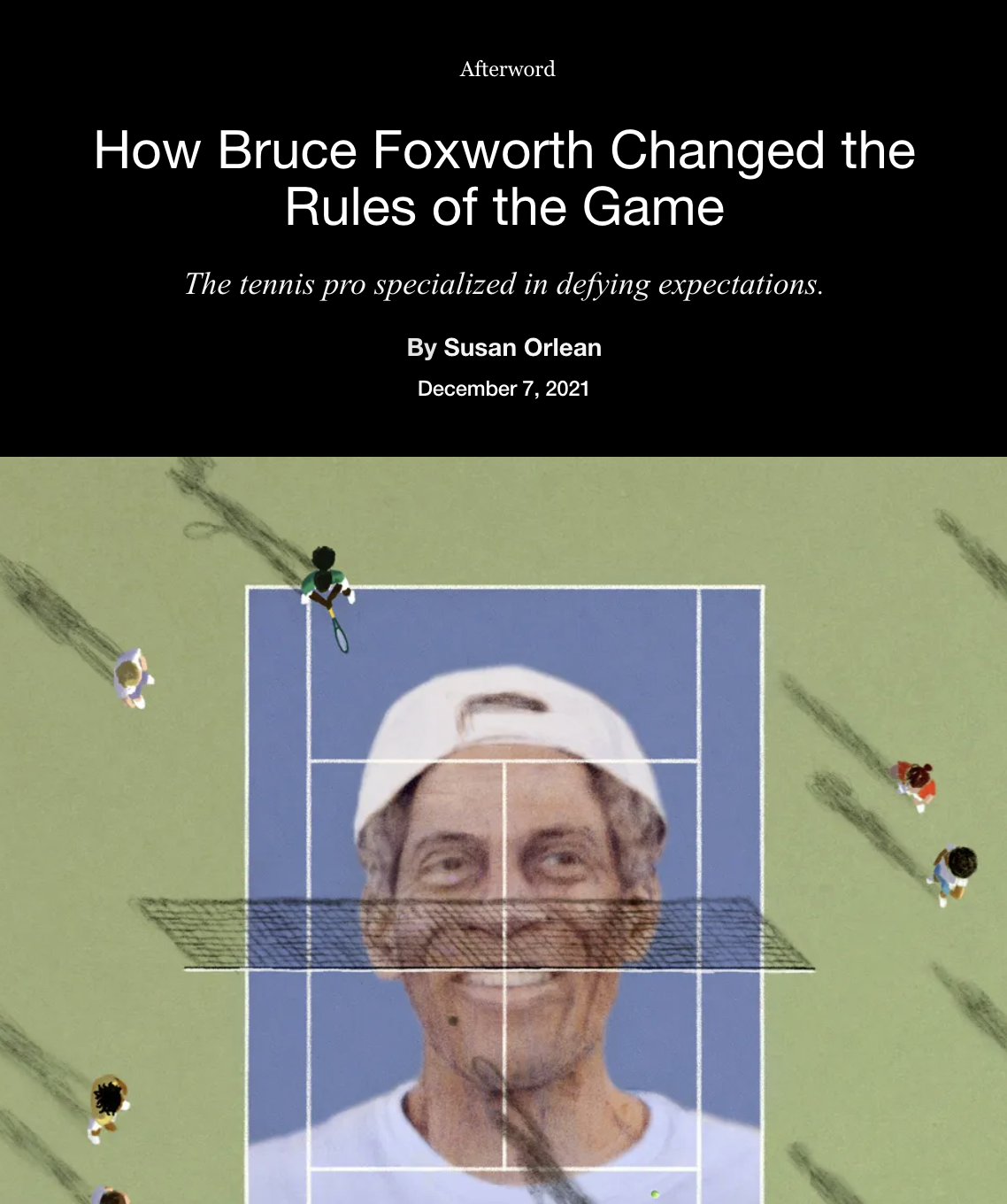
His tennis game was one of those silky, strategic ones: he would push his opponents to the corner of the court, pinning them to the line, and then finish them off with an elegant tactical shot that was maddeningly out of reach. Bruce Foxworth (1956-2021) was a cat of a player, cool and easy, something of an anomaly in a game of smashing forehands and power serves. He never broke into the top ranks of players on the professional circuit, but he held his own there and supported himself with his tournament winnings for a decade, making appearances in the main draw at Wimbledon, the U.S. Open, and the French Open.
Maybe the theme of Foxworth’s life was anomaly. He was an African American kid from St. Louis who picked up the game when professional Black tennis players were still relatively uncommon. His father had been a Golden Gloves boxer, so Foxworth grew up steeped in sports. (The family living room was decorated with a photograph of the elder Foxworth, dukes up, with Joe Louis.) He picked up tennis at the speed of light and could take a set off his father when he was seven years old. From his father, he also inherited the conviction that jumping rope was all the conditioning you needed as a serious athlete. His training program was simple: he ran and jumped rope, hard, every day. He was an outlier compared with the other pros on the circuit, who travelled with a royal flush of trainers and nutritionists and fitness consultants and physical therapists.
Foxworth’s family were Christians, but he began reading the Torah on his own during high school (he sneaked glances at the Old Testament during church services) and continued to do so with a student group when he attended Hampton Institute, a historically Black school in Virginia, now known as Hampton University. Throughout his life, he read the Torah every day. His defiance of expectation faced the ultimate test in 1992. By then, Foxworth had retired from the pro circuit and was teaching tennis for a living in Los Angeles. One night, he flipped his ancient Datsun truck on a wet, curvy canyon road and broke his neck, a terrible injury that nearly guaranteed that he would not walk again. But, in time, he did. He could no longer glide around the court, but, with the help of a motorized scooter, canes, and grit, he eventually was able to feed balls to his students, and over time he built up the strength to stand for hours during lessons. It turned out that he was very good at coaching verbally. He could describe what he wanted his students to do so well that it didn’t seem to matter that he couldn’t demonstrate it.
Foxworth had a devoted following at The Tennis Place, a pay-to-play facility in Los Angeles. He was famous for being preternaturally calm—a departure from the kind of coaching that was then popular, in which a student was screamed into cowed submission. “He didn’t yap a lot,” one of his students, Melissa Nguyen, said. “He never yelled. He had no anger in him. He was deep.” Several of his students at The Tennis Place happened to be members of the Los Angeles Tennis Club, an exclusive private institution in the elegant neighborhood of Hancock Park. Founded in 1920, the L.A.T.C. was long rumored to limit membership to whites and non-Jews, and it enforced exacting dress codes. (Perry T. Jones, who, starting in the nineteen-thirties, organized tournaments and programs at the club, which he ran, according to the Los Angeles Times, “the way Ivan the Terrible ran Russia,” once excluded a preteen Billie Jean King from a group photo because she was wearing shorts rather than a tennis skirt.)
Foxworth would not have seemed a likely hire for the club. But the members of the L.A.T.C. who took lessons from him across town pushed for the club to hire him as the director of its junior program. The program was nationally renowned; Jones had mentored such players as Stan Smith, Jack Kramer, Bobby Riggs, Dennis Ralston, and King. Foxworth’s wife, Geri, whom he had met at The Tennis Place, recalled walking with him through the L.A.T.C. for the first time, years earlier. “I won’t try to describe how people looked at him,” she said. “I just can’t even describe it. I had to hold my tongue. But it didn’t ruffle Bruce’s feathers at all. He knew exactly who he was and was completely comfortable with it.” He took over the junior program in 2000 and ran it until his recent death from prostate cancer.
He had initially said that he wouldn’t take the job at the L.A.T.C. if he had to cut his hair, which he then wore in thick dreadlocks. He did, though, tuck it under a cap when he was at the club. “He even agreed to wear an L.A.T.C. cap,” Geri Foxworth said. In time, he didn’t feel it necessary to wear a cap, and his dreadlocks flourished for the rest of his life.
Afterword is an obituary column that pays homage to people, places, and things we’ve lost. If you’d like to propose a subject for an Afterword piece, write to us at afterword@newyorker.com.